Seasons in the Sun – Quilt Framed!

I show you how to frame your finished quilt behind glass, even adding a border!

My quilt of my son…probably my dearest quilt!

My quilt Seasons in the Sun has been lying around in a shelf for over three years now! I live in a dusty place and it was necessary to put it behind a glass frame. In any case, it did not even have a hanging sleeve!

I was also not sure how to hang it behind glass and browsed the web for a solution. I finally decided to get a box frame made, fit it with a hanging rod and hang the quilt inside. The carpenter was ready with box frame a few days ago, but I could not get myself to stitch yet another quilting sleeve (after two on the Dreamcatcher and another on my son and daughter-in-law’s portrait quilt! That reminds me that I am yet to share pics of that portrait here).

So I was saying that adding hanging sleeves must be the most tedious part of quilting and I wanted to avoid it come what may! I decided I would mount it on board, like pictures are, but how? I did manage to work out something, and here is a mini-tute explaining what I did and why.

How to Display a Finished Quilt Behind Glass

Preparing your Quilt

1. Measure your quilt as accurately as you can, including the binding and then measure the finished binding. My quilt measured as follows

36.5″ x 50″ including binding. My binding was 1/2″ finished, so excluding the binding, my quilt finished at 35.5″ x 49″.

2. You need to decide if you want a border around the finished quilt. I had to add a 5″ border beyond my final quilt size, because I was working with a frame that was already made.

3. Once that is decided, you can calculate how much fabric you will need.

If adding border:

Fabric 1: Can be any solid ; I used inexpensive poplin. This has to be equal to the size of the quilt minus the binding plus total 1/2″ for two seams. I will call this the backing fabric.

Fabric 2: For the border. I could not decide what I wanted for the border. I would have liked a sky blue mitered border, but I did not have enough of the fabric in my stash. I also did not have enough green fabric in a single colour, so I pieced my border using whatever I had at hand.

To calculate the fabric needed for the (unmitered) border:

Width of border:

Width of border+ width of binding + 1/4″ for seam joining border to backing + 1.25″ to wrap to the back of the mounting board.

In my case this was 5″ + 1/2″+ 1/4″ + 1.25″ =7″

Length of border:

2 readied strips, width of border x length of backing ( for me 35.5″x7″)

and

2 strips of width of border x width of backing plus two widths of border minus 1/2″

( for me 7″x 49.5″ plus 14″ minus 1/2″, that is 7″x 73″)

If not adding border

Make a backing fabric equal to final size of quilt plus 1.25″ all around ( to wrap over and to the back of the mounting.

You may be tempted to skip the backing all together, but adding an additional backing protects your quilt, because it ensures that it does not come in direct contact with the board.

4. Prepare your backing by adding the borders. Spray starch and press all seams.

5. Sew the backing to the quilt:

Lay the prepared backing flat, right side facing up. Arrange the quilt, also facing up, on top of the backing. ( I spray basted the two layers together!)

Pin-baste these two together, so that the binding seam of the quilt falls exactly over the seam joining the border to the prepared backing. Now we are ready to sew.

You can machine sew, exactly at the inner edge of the binding, turning over frequently to check that you are not straying from the seam line on the fabric below. I did not feel confident about machine sewing, so I flipped over the pinned- basted layers. I folded the border back on the backing and slip-stitched the two layers together. I could ensure that the seam line on the backing fabric was joined to the seam line of the binding on the quilt exactly. That at the end of it I was left wishing I had stuck to a hanging sleeve, is quite another matter!

Border added to finished quilt!

Once this was done, I folded the border back and ironed it. Here you can see how it looks. The binding is free, not stitched down, and I like that ‘quilty look’.

If not adding a border, the mount has to be exactly the size of the quilt.

The Frame

I do not know any technical carpentry terms, so this is going to be written in a layman’s language!

I wanted teakwood for the 2.5″ wide frame, but the carpenter recommended pinewood, saying it was lighter. I did not want a simple frame, so I extended the bars beyond the frame. I designed the frame with the horizontal bars longer than the vertical ones to enhance the expansive feel the final picture would give.

The frame designed to give an expansive feel to the final picture.

The original plan, as I mentioned, was to affix a rod inside the frame and hang the quilt inside. But, with my change of plans, the hardboard that was screwed on to the back of the frame was removed and trimmed to fit inside!

– So, first the glass was fixed with strips of wood (1/2″ square section). I hunted across my city for plexi-glass, which would be non reflective, but it was not available anywhere. I then opted for the thinnest glass, 4 mm(?) thick.

– Next, the prepared quilt was stretched across the mount, the edges wrapped to the back and secured with painters tape.

We did think of gluing it to the back, but decided this was a better solution, as it would be easier to remove in case needed.

-The quilt was now placed inside the frame. Note that it does not touch the glass, because of the 1/2″ thick wooden strips between the quilt and the glass.

– The hardboard mounted with the quilt was secured with wooden strips nailed over it into the frame ( the way glass is). So no nail goes through the fabric anywhere.

– Ready!

I do believe this looks much neater than just hanging a quilt inside a glass box! I am now planning to frame more of my quilts to display them without fear of dust ruining them! And without harming the quilt in any way with glue or nails etc!!

Here are some more close-ups!

I love the way the binding acts as an inner frame to the main quilt.

I matched the add-on border to the binding!
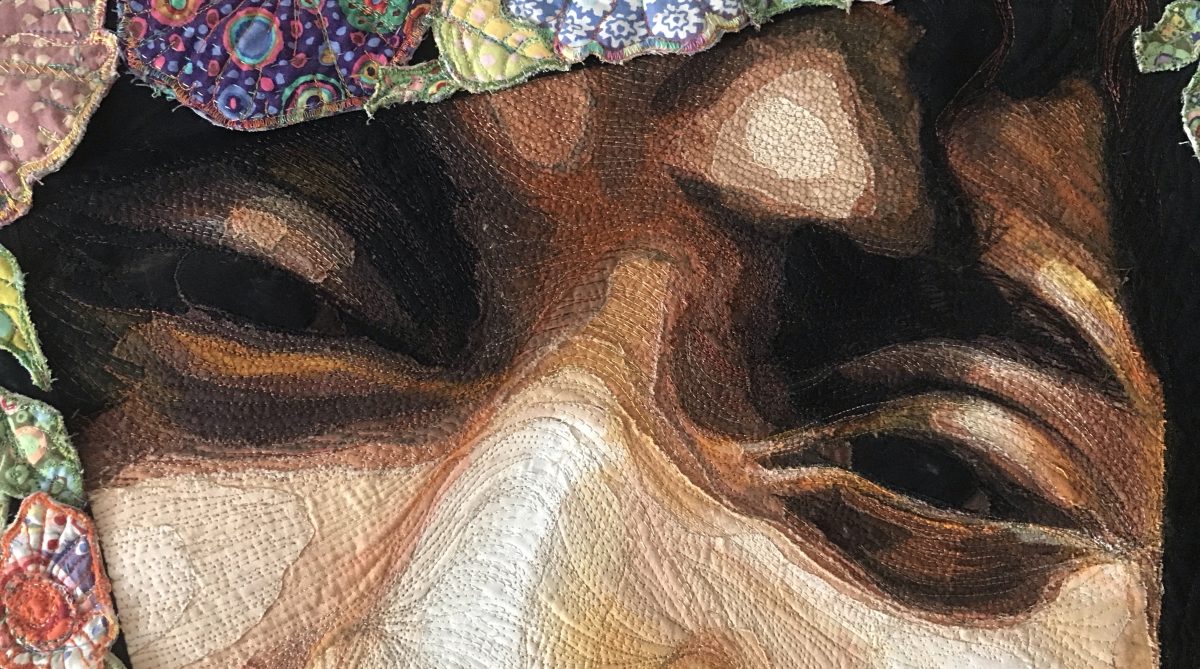
I touched up the face with Derwent Inktense pencils before framing!

Quick and Easy Nine-Patch Quilt Blocks

The Quick and Easy Nine Patch Block…

After several weeks, I finally got around to a little bit of sewing and I decided to try out a YouTube tute on an easy and quick method for a nine-patch block, which I had seen long, long ago!  In fact, almost five years ago, I had adapted this method to test and write one of my most popular tutorials, the one on how to sew an easy and perfect four-patch. So without much ado, here we go on my adaptation of the same tute to make several nine-patch blocks in a batch!

I will do this tute in two parts. In the first I will show you how I made several nine-patch blocks in one go.  In the second part I will give you Maths for various sizes and some tips, including those for perfectly matched points on your blocks.

The Method

For my project, I need several nine-patch blocks of 0.75″. Yes, you read that right, 3/4″ blocks! Almost impossible to manage by the regular methods, one would think, since each of the nine square patches would be 3/4″ to start with, and end at 1/4″!

1. I begin with 2 strips of 2.5″ width in the fabrics I will be using for my block. Actually 2.25″ would have been sufficient, but remember a good rule to follow when working with miniature blocks is wherever possible,  sew bigger and then trim to size.  I will discuss the length of the strips later.

Begin with 2 strips 2.5″ wide

2. I sew a scant 1/4″ seam on both long edges.

Sew 1/4″ seam on both long edges

3. Now  I do something one doesn’t usually do! I trim the seams by about 1/16″ or 4-5 threads. Remember the final size of the pieces is only 1/4″? Unless I trim the seams, things are going to get difficult and messy at the back!

Trim the seams by about 1/16″

4. Measuring from just inside the seam, I make a long cut 1/2″ inside on the joined strips. ( 1/4″ is the size of the final patch, plus 1/4″ for the seam. ) Similarly inside the other seam.

Cut 1/2″ inside both the seam lines…Note the placement of the ruler. The 1/2″ mark is just inside of the seam line.

5. I now have this:

Two pink-white strips and  one each of pink and white strips about 1″ wide.

One pink strip, one white strip and two joined pink-white strips

6. I press open the two pink-white strips…

Important: Do not iron open the seams. Instead, press them to one side. I ironed them to the darker, pink side.

Press the seams on both strips to one side, towards the same colour. I chose to press mine to the pink.

7. I now sew the pink strip and the white strip to these, to get one pink-white-pink and the other white-pink-white strips and press it open, seams are again pressed to the darker ( pink) side.

Iron open the pink-white strips. Do not press open the seams; instead, press the seam to one side. Again, be consistent. I press the seams to the pink as I did on the previous stage.

8. Measuring from just beyond the seam, I trim the newly added pink strip to 1/2″. Had I worked with 2.25″ strips, this would not have not been required, as my recently added strip would have been 3/4″ instead of 1″.

Trim newly added strip to 1/2″ width.

9. And similarly, the white strip.  The final white-pink-white strip will be just the scantiest bit wider than 1.25″, as will be the pink-white-pink strip.

Trim white strip to 1/2″ width from just beyond seam.

10. I now cut 2.5″ long pieces from the lengths of the two strips.

Cut 2.5″ long pieces from the strips…

I had begun with 10″ long strips, so I have 4 pairs of 2.5″ long strips at the end of this stage. ( I now made another 5 sets of these readied strip pairs, using 12.5″ strips, so don’t let the coming pictures confuse you!)

11. Now comes the most exciting part, where the magic starts to reveal! I pick up each pair, right sides together, and sew 1/4″ seams along the shorter edges. I had pressed the seams towards one colour; this ensures that the seams ‘lock’ and my points match beautifully. 

Pair the pink-white-pink strip with the the white-pink-white strip and sew 1/4″ seams along the shorter edges.

Remember, chain stitching makes things move really fast!

12. You may have guessed what comes next? A cut 1/2″ from inside both seams. I could, of course, measure 3/4″ from the edge. But measuring from the seamline ensures accuracy of my ready size, because it takes into account that my 1/4″ seam may be a tad more or less than 1/4″!

13. Have we forgotten something here? Yes. We had to trim the seam (allowance) by 1/16″.

Cut 1/2″ within seam. Can you see that my seam is uneven? Measuring from the seam ensures my final strip will be accurate and the correct width!

14.  Press open the (6-patch) side pieces; again, seam to one side – do not press seam open.  Which side? I pressed half of them on one side and the remaining nine on the other and made two separate piles of these 6-patches. I realised later this could get a little complicated with regular sized blocks! How?  I will try to answer this later in the “Tips” section.
I joined the centre strips to side pieces appropriately. the white-pink-white to one pile and the pink-whie pink to the other.

Almost there!

15. Once sewn, I first press the seams towards the edge and am ready for the last step …

18 nine-patches in no time at all! All pressed. Just one more step…

16. …the last strip joined has to be trimmed to 3/4″.

Trim to 1/2″ from the seam. This is a good time to check all edges and trim them as necessary to get an accurate 1.25″ square.

Here we are, the final eighteen!

Nine blocks have white squares in the corners and centre. The other nine are reversed.

The Maths

Width of Strips

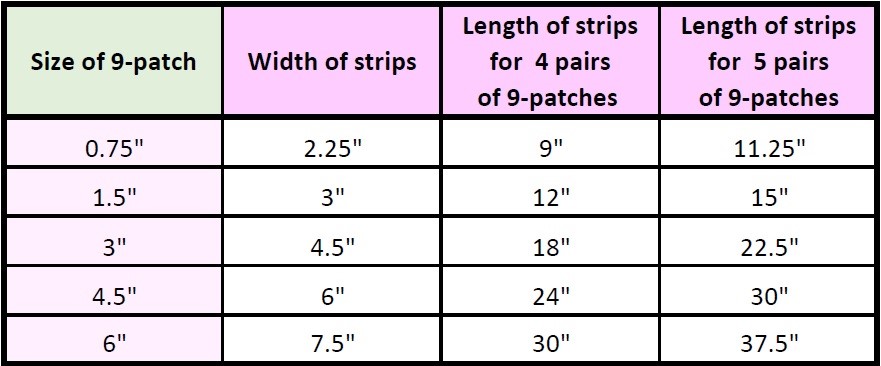
The Maths is very simple. Just add 1.5″ (for 6 seam allowances of 1/4″ each) to the size of your ready nine-patch, to get the width of your strips. So if you want a 6″ patch, begin with 7.5″ strips, if you want a 3″ strip, start with  4.5″  wide strips.

Length of Strips

This will depend on the number of blocks you need.  The minimum nine-patches you can make by this method is two, one the colour reversal of the other.

If you need just two blocks, begin with 2 squares. The size of the square? Easy! Size of ready nine-patch plus 1.5″ . So for a pair of  6″ nine-patches, you need two squares of 7.5″. And, if you need a pair of nine-patches of 3″, start with two 4.5″ squares.

If you have a set of 5″ charm squares lying around and are wondering what to do with them, it may be a great idea to pair up contrasting colours and make  3″ nine-patches with them.  The strips will have to be cut at 1.25″ from the seam at Stage4 and the centre strip will require trimming as it will be 2″ wide.

Add one width to the length,  for each extra pair that you require.  For two pairs of 6″ squares, the two strips will be 7.5″ x 15″. For 3 pairs, 7.5″ x 22.5″, for 4 pairs 7.5″ x 30″ and so on…

Tips 

  1. Caution: This method gives you two sets of nine-patches, which are colour reversals of each other. It will not work if you want identical nine-patches. Of course, you could put away the unwanted 9-patches for another project or use them in a border or something. If doing miniature blocks like I am making, I recommend this method every time. You can always use up the extra blocks.
  2. I am repeating myself: press the seams to one side, consistently. Like  I said, things get complicated when we reach the last stage of assembling the nine patch.

a) If making mini-blocks, press towards the strip which will be on the edge. Thus if you are making a block with 5 pink patches and 4 white ones, press towards the strip which has pink-white-pink patches. And vice versa with the colour reversal patch. In other words, half of them to one side and the other half to the other, like I did. Your finished nine-patches will look like this from the back. The last two seams face the edges.

The two patches from the back…

b) If making regular sized blocks, which will be attached to other nine-patch blocks to make perhaps a border or larger units, I would follow the traditional method. Press seams on the blocks in one direction consistently, towards the pink-white-pink strip. In half of these blocks ( 5W-4P) the two last seams will end up facing each other towards the centre, in the other half  (5P-4W) towards the edge. Then when these nine-patches are being joined together, seams will lock in to give you perfectly matched points.

c) If making regular-sized blocks which will not be attached to other nine patches,  press seam towards edge like in a) above.

Well, I really can’t think of anything else, so…

Are you wondering what I am going to do with all these miniature 9-patches? What is coming up next? Well, you’ll just have to wait and watch, won’t you?

I sign off wishing all my friends across the world a Very Happy Diwali, the Hindu Festival of Lights! May our Earth see the victory of prosperity over want, of peace over war, of good over evil,  of health over disease, of hope over despair, of love and compassion over hatred…of light over darkness, everywhere and for all its inhabitants.


Cathedral Window Patchwork Maths – How Many Windows? 

The number of ‘window panes’ in a traditional cathedral window quilt is not the same as the number of background squares. It is many, many more! So how do you know how many fabric squares to cut? Here is the Arithmetic!

Caution: Loaded with primary school level Arithmetic. Read at your peril ( or if  you plan to make a traditional cathedral window quilt).

There are plenty of tutorials which tell you how to make a traditional window quilt, including mine, here. There are also tutorials which tell you, given the finished square design, how big your background fabric square and window (pane) square should be.  For example, if you want to finish with a 5″ square, your background fabric should be 10.5″ square, and the window fabric 3″. This is the tutorial I referred to for measurements for my current project.
However, did you know that the number of window squares you need are not equal to the number of background squares in your quilt? What was that again? Well I was working with these 3×3 patchwork pieces, and I cut 9 window patches for each. The result is here for you to see!


There are three blank ( white) window ‘panes’ in each. I should have cut 12 window (black and white) squares for the centre windows. If I wanted the printed fabric in the (half) windows on the edges, I would have had to cut 12 more squares ( which I would have folded diagonally and attached to the ‘frames’).

Things get even more complicated when you are working on a larger quilt.  If you are working with, say, 24 squares and making a 6×4 or 2×12 or 3×8 quilt, you would now have guessed that you need more than just 24 window squares.  But, did you know that the number of windows is different for each one of these? And none of them is 24.

So how does one do the Math? If you are one of those people who just can’t wrap their head around figures, well…I guess there is nothing to be done but to cut the fabric in batches as you go along. It is impossible for me to make a chart here with all the possible block configurations!

For the others, here is the way it works!

The Arithmetic

All you need to know is

– the total number of background squares you are working with and

– the configuration of your quilt. What is meant by configuration?  If the total number of squares is 36, you could be joining them in a 6×6  or 4×9 or 3×12 configuration.

It does not matter what the size of your squares is.

Step 1. Multiply the total number of squares in your quilt by 4. If my quilt has 36 squares, I will get the figure of 144.

Step 2. Calculate the number of ‘half’ window panes at the edges. This is equal to the total number of squares at the edges (perimeter).

If my quilt configuration is 6 x6, the total number of half window panes is  6 + 6 + 6 + 6 = 24

If my quilt configuration is 4×9 , the total number of half window panes is 4 + 9 + 4 + 9 =  26

If my quilt configuration is 3×12, the total number of half window panes is 3 + 12 + 3 + 12 = 30

If I plan to add a ‘pane’ fabric to these half window panes, I need to cut these many squares in addition to the rest I will be cutting. ( Like mentioned earlier, these will be folded diagonally and attached to the window, with the diagonal fold at the edge. )

Step 3. Subtract the number of half window panes from the figure obtained at Step #1. This result is divided by 2 to get the number of full window panes for the centre!

If my quilt configuration is 6×6, the total number of half window panes is 24. If I subtract this from 144 , I get 120, which I divide by 2 to get 60! So that is the number of window fabric squares I need!

For the 4×9 configuration, I get 144 minus 26, which is 118 and the number squares will be 59.

The 4 by 9 configuration. Ignoring the 26 brown half squares at the edges, can you count 59 window squares in the centre, including the 12 left blank?

For the 3×12 configuration, it will be 57 squares in the centre and 30 ( half) squares at the edges. Check this out!

57 window panes in the centre and 30 half panes at the edges…

Not so complicated, right? Let us crosscheck this with my 3×3 cushion cover!

Cross-checking the Calculations
Here is my cushion cover, with the nine blocks in a 3×3 configuration.

The red lines mark the background blocks in a 3×3 configuration

Had I added the black and white printed fabric to the half windows at the edges,  I would have needed 12 squares ( folded diagonally into half) for those.

The number of panes at the edge are equal to the number of blocks along each of the edges totaled together.

As for the centre squares, I subtract 12 from 36 ( total number of background squares multiplied by 4) to get 24 and halve it to get 12!

That is 12 printed fabric window squares needed for the centre panes ( marked in lime green).

But I had cut only 9 black & white printed squares.

Not enough fabric squares to cover all the windows?!

Explains my 3 missing squares quite neatly, doesn’t it?

Where did those 3 blank squares come from?!

I hope I have been able to make some sense. Remember to bookmark this post if you plan to sew up a cathedral window quilt anytime. It will make more sense then, I am sure.

Scallops and Irises – A Wonky Log Cabin Mini Quilt

Scalloped borders with facing on the mini…

I don’t remember if I blogged about this miniature quilt, which I began exactly a year ago, to the date! 

The nine 2.5″ blocks had been foundation paper pieced and joined, waiting for the border and the binding, all of which was cut out and waiting.  I have been long wanting to experiment with a scalloped border and this seemed a good place to try it out!  It took me hours to do this, because I could not find any tutorials on this. It seems every time I want to go somewhere, I have to invent the wheel!

So here is a pictorial tute on how to make scallops on the border to your mini! If anyone is interested in the scallop pattern for a 10″ mini quilt, you can message me on my Facebook page ‘Patchwork of my Life’ and I will be happy to share it with you.  You can increase the number of scallops in 2″ increments ( or reduce them!). 

1. Get your quilt top ready. Add the batting and backing, ready for quilting. 

2. Quilt the centre of your quilt, leaving the outermost border ( which will be scalloped) unquilted. I did a simple stitch in the ditch around the blocks and  inner deep purple border.

3. Pin the scallop pattern on the border, leaving 1/4″ seam allowance beyond the paper pattern.

The 1″ wide scallop pattern was pinned in place on the border. Note the 1/4″ seam allowance beyond the border.

4. Mark the outline by stitching on the scallop line. I used a 1.5 stitch length. 

Sew along the scallop line.

5. Remove the paper; the small stitch length makes it easy. 

Remove the paper.

6. Trim the seam allowance to 1/4″ beyond the scallop. ( I also added a line of echo quilting within the scallop). 

Do any further quilting that you wish to. Trim the seam allowance to 1/4″ beyond the scallop.

7. When I reached this stage, I realized that I needed a bias binding for the scallops! And all I had was a 1.25″ wide straight binding, which I had no intention of letting go waste. So I decided to do a facing. 

-If you wish to add a binding, remember you need bias binding! Sew it on as you would regular binding. Just one thing,  you will need a much longer strip than for a straight edge. I have not calculated, but for this quilt, I had made a strip 70″ long instead of 50″ which I would have done for a straight edge. Also, sew down the binding very slowly and use the needle down option if your machine provides it. Stop as often as you need to adjust the layers. Curves are not difficult to handle – look only at the stitch immediately ahead of the needle, ignore the rest! I would suggest notching the seam allowance on the inner curves, especially, before turning over and securing the binding. 

– If you want to add a facing ( much simpler), here is how you go about it. 

Attaching a facing to a scalloped border

i) Prepare the facing:  The facing should be wide enough to go at least 1″ beyond the inner curve of the scallop. Put a ruler on the quilt, the ruler edge touching the outer ‘fat’ convex edge of the curve. See the reading on the inner edge of the curve. For example, if this is 2″, the facing should be 3.25″ wide, including 1/4″ seam allowance. I had originally intended to add a binding to my mini quilt, so I had ready 1.25″ strips. I decided to go ahead with these. I think a 1.75″ strip would have been more convenient. 

The total strip length needed for this 10″ square was about 50″. Turn in one long edge about 1/4″. I did a machine zigzag after folding the edge. 

Fold in one long edge about 1/4″ and secure it. A zigzag stitch is used here.

iii) Preparing the quilt: This may look tedious, but will give you a great finish! Remove the batting ( use a pair of sharp embroidery scissors) from between the two fabric layers on the outermost seam allowance on the quilt edge.

Trim away as much of the batting as you can from inside the seam allowance. Use sharp embroidery scissors.


iv) Attaching the facing. Line up the raw edge of the facing with outer ‘fat’ curve edge on top of quilt . Begin at one corner – remember to extend the facing a couple of inches beyond the corner. Pin if you are more comfortable with that. Turn over to backing side.  Start  sewing  over the scallop outline already marked by the stitching line.

Line up facing strip on edge of top of quilt. Sew over scallop outline from backing side

v) When you reach the corner, make a mitered corner as you do with regular quilts and turn the strip.  Pin in place and continue sewing over the outline.

Turning the corner – view from the back.
Turning the corner – view from front

vi) Go around sewing over the outline, stop a couple of inches before you reach the corner where you began. Turn the strip end ( where you began sewing) to form a  ‘mitered’ 45 degree fold.


When you reach the corner where you started, fold the binding to form a sharp 45 degree fold.

vii) Now bring the other end of the strip to lie over the folded end. Pin in place, turn over to backing side and sew over the scallop outline, continuing around the corner and beyond. Trim the excess fabric, extending beyond the corner! 

Simple! Isn’t that?

viii) Just a couple of steps more and we are done! Trim the seam line – from the backing side, of course – and make notches all along the curves. Careful! Don’t get too close to the seamline! However, where there are lots of layers of fabric, like in the corners, try to trim off as much of the excess fabric as you can.

Trim off the excess fabric on the facing strip…
Notch, notch, notch!

ix)Slip stitch the overlapping corner folds together. ( Right bottom corner in the pic below)

Slip stitch together the overlapping folds in the corners.

x) Turn the facing over to the back …

Facing turned over to the back…

xi) …and press the life out of that edge! 

Press down the edge as flat and sharp as you can. Lots of layers here, so this is an effort!

xi) Secure that edge with stitching about 1/8″ within. This quilt is exactly 10″ square, outer curve to outer curve, unlike if it had a binding, which would add the width of the binding to it. 

Done! I like it with a facing instead of a binding!

Now for some close ups…

Secure the facing with stitching 1/8″ from the edge
A picture to show you that I make mistakes, have fabric bunching up, etc, etc…

One final close up! 

I used Fossil Fern by Benartex for the quilt top. The backing fabric is batik from The Square Inch…

I will be happy to clarify if there is any confusion regarding this method! 

Because I Am Itching To Show Off…

The centre of the Dreamcatcher Round the Year Quilt