
The quilting on the outermost dark blue border of the Dreamcatcher Dusk Round the Year has begun! As you can possibly see, I am thoroughly enjoying it.


The quilting on the outermost dark blue border of the Dreamcatcher Dusk Round the Year has begun! As you can possibly see, I am thoroughly enjoying it.
Here are some more layout options for the 8-block Rainbow Dreamcatcher Round the Year Quilt!


By now, I am thoroughly confused. The Consultant still votes for Layout 3! I think I will put away this quilt for the time being and come back to it after a month.
Managed to finish only eight of the Dreamcatcher Round the Year BOM blocks? Here are layout options for queen sized quilt with as few as just five blocks!
I ended up making only eight of the sixteen Dreamcatcher Round the Year BOM blocks in the Rainbow colourway.
Now, eight is a pretty odd number of 18″ blocks to end up with, if you are wanting to make a queen sized quilt. In no mood to make any more blocks and not sure of how I was going to put them together, I tried out various layout options.


One could place the blocks in two columns and off centre them, adding borders on either side. It has a lot of negative space and the quilt doesn’t look too busy…

This is the same that I have used for the Dusk Dreamcatcher. Again, this gives me lots of negative space and the blocks look nice like this, I think.
However, I do want this layout to be different from what I have already done. To clinch the matter, The Husband responded with a grimace when consulted about this! Perhaps blue flying geese will look better than blue? No. I really do not want to do the same setting in this quilt. So we move to the third layout!

Here, I use only 5 blocks in a row, towards the foot. The bottom border is strips of various widths in white, black, the white & black prints and blues, greys used in the blocks. The top border is just 2-3 strips and only a 1″ blue border on the sides. Two blocks are made into cushion covers set in blue squares and one into a framed wall hanging!
While I have approval of the Consultant in Residence, I would still like your opinion. What do you think will work best?
I have always found the glorified 9-patch, which is a nine patch in a circle, very pretty …as also the Pickle Dish block! I drafted this block for my Round the Year quilt, combining the two in one, though this is not truly a pickle dish, and the block looks like a thorny 9-patch to me! So that is what I plan on calling it – the Thorny 9-patch or perhaps the Crowned 9-patch. Unless you can think of something that sounds nicer?
This was left out of the final sixteen that made the cut, as were some others. It would be nice repeated all over in a quilt too, methinks! I have made one for my Rainbow quilt, which I plan to do with just eight blocks. Meanwhile, I search for appropriate fabric for the background – the squircles, as I like to call them. I like the idea of using Moda’s Zen Chic Ink ( or Paper) Handwriting or Notes or even Newsprint. The logistics of buying it is not working for me right now. So, I guess this quilt will have to wait.
I now finally start working on finishing the Dusk quilt. Will keep you posted on the progress!
Meanwhile, will you help me decide which of the two placements of the thorny crowns you like better? I prefer the second, I think!


This is a block that has given me much heartache , and that story deserves its very own blogpost! Meanwhile, here it is, Dozens Squared, the twelfth block of the Round the Year Block of the Month Quilt.

The block finishes at 18.5″ square (including seam allowance), with a 15″ inset circle. It is partly paper foundation pieced; the templates and instructions can be downloaded in PDF format from the links at the end of this post.
What’s in a name?
This Block 12 of the Round the Year BOM Quilt is inspired by the beautiful Jack’s Chain block. I couldn’t decide what I wanted to call it. I thought of something to do with 9-patches and then Jill’s Chain! But then I counted the number of pieces in the circle – 144. It could not be chance that Block Twelve should contain twelve twelves, could it? The name would have to to have some reference to this, I thought. No way I was going to call it ` Gross’, which is the correct nomenclature for a dozen dozens! Dozens Squared sounded better, also as the dozens would in any case be inset in a square!
The fabric requirement for the block is given for the Dusk colourway. I have scrapped the block that I made in the Dusk colours (not this) – I thought it looked quite ugly (gross?)!

| Fabric Colour |
Fabric Code |
Background |
Nine patches |
Centre |
Spiked wedges |
Circle edge wedges |
| Lightest blue |
1 |
19″ square OR 10.5″ x 25″ |
Two 6″ squares | 2.25″ x 8″ | ||
| Medium Blue |
4 |
Two 6″ squares | 2.25″ x 8″ | Two 2″ x 8″ | ||
| Medium-dark blue |
3 |
Two 6″ squares | 2.25″ x 8″ | Two 2″ x 8″ | ||
| Deep blue |
2 |
2.25″ x 20″ | 2.5″ x 36 2.0″ x 36″ |
Two 2″ x 8″ | ||
| Yellow |
8 |
2.25″ x 6″ | ||||
| Gold |
6 |
2.5″ x 12″ 2″ x 12″ |
||||
| Light Orange |
7 |
2.5″ x 12″ 2″ x 12″ |
||||
| Orange |
5 |
2.5″ x 12″ 2″ x 12″ |
Please refer to the downloadable Instructions File, if you want detailed cutting instructions!
Please remember to print the Templates file with your printer
setting at 100% or Actual size in portrait mode. Cut out the paper piecing Templates.
I recommend printing also the Instructions file and keeping the Master Template (provided in the Instructions File) at hand when assembling the block. A line drawing version of the Master Template is also included in the file (also a mirror image ). You can use colour pencils to experiment with your own colour combinations!
Piece the six 9-patches A, B, C, D, E and F using the quick 9-patch method. The pictures I am showing here are for the rainbow block. You will start with 3 pairs of 6 inch squares.


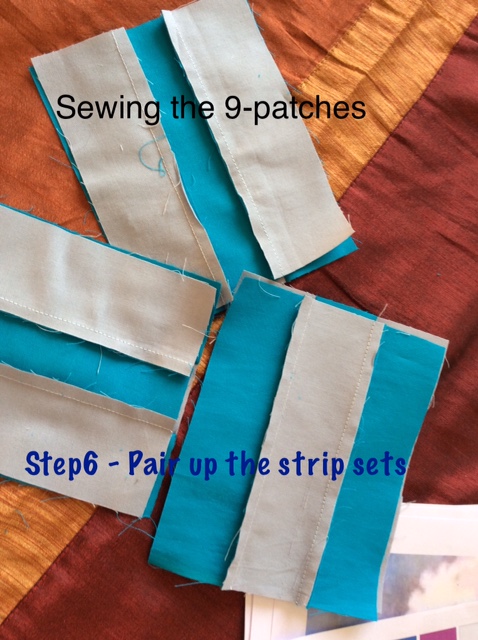


For the block we need 9-patches which finish at 3.5″, so we will need to trim these to 4″, with centre square remaining at 1.5″.

You could also use the template A to match and trim the 9-patches to size.

I would suggest cutting the strips into triangles before you start piecing. Lay the 60 degree line in alternating directions as you cut the triangles – remember to leave 1/4″ on the top before you cut in the opposite direction.

If doing the Rainbow block, I may mention that a 6″ x 2.25″ yields 3 traingles quite comfortably. I used 8 different colours for the centre.

In no time, you would have the templates S, T, U, V, W and Xpieced. Put these aside.
Now we come to the 12 spiked wedges G, H, I…Q, R.
Each of these wedges has 5 pieces. Before you start the actual piecing, I suggest you pin pieces # 1 (2.5″ x 1.5″) and #2 (HST 2.5″) on all the templates. This helps save time in sorting colours and sizes of the upcoming pieces!


Chain piecing must be the greatest innovation in sewing, don’t you think? In no time we are ready for piece#3, (which is the largest piece, at 2″ x 4″)


Trim the excess seam allowance.

Press open. Piece #4 is easy! Just align the long edges of the two pieces and sew!

Chain piecing, as usual!


We are ready for the last step – sewing piece #5 – a rectangle 2″ x 2.5″ ( I used 1.5″ x 2.5″ rectangles, but they made a tight fit, so I have changed the width to 2″.) Again, please check the rectangle placement before sewing to ensure you have the paper section fully covered.

All our piecing is done, all that remains is the assembly!
Assemble the block, using the Master Template as a guide. Remember, the Master Template is a mirror image and shows the block as it would look from the printed paper (reverse) side. As seen here, what is on left appears on right and vice versa.

1. Sew the spiked wedge (halves) to either side of the respective 9-patches.
Sew G and J to opposite sides of A; M and P to opposite sides of C; H and K to opposite sides of E;
Sew N and Q to opposite sides of B; I and L to opposite sides of D; O and R to opposite sides of F.
2. Sew the centre pieced triangles to the 9-patch template sets.
Sew S to GAJ; V to MCP; T to HEK; W to NBQ; U to IDL and X to OFR.
3. Sew the respective circle edge wedges to the just assembled template sets. Here is some auditioning of fabric for the circle edges…


…before I settle on this!

Option 1
Join background pieces AE1/ AH1 to wedge set containing A and B;
Join the background pieces AF1/AI1 to wedge set containing F and E;
Join background pieces AG1/AJ1 to wedge set containing D and C.
Join in threes – pieced set AE1, AF1 and AG1 to form one half; and the other 3 pieced sets to form the other half
Join the two halves to form the full block.
Option 2
Join the pieced sets to form the full circle and appliqué it to the background square using your favourite method.
Trim to 18.5″ square.
Here is a look at the Dusk version of the Dozens Squared block

Please note that the downloadable patterns with paper piecing templates and instruction files for the Dreamcatcher Round the Year quilt blocks have been migrated to my store MadsPatch and are not be available for download for free from 15th November 2020 onwards.


You must be logged in to post a comment.