I am overwhelmed with emotion when I try to write anything about this portrait of my daughter…I will try to just stick to photos of how it was done!
This photo, so quintessentially my Tana, was my inspiration for the quilt! I started working on it in January 2022, about a year from when she passed on.
Vectorization done on the Vector Q app
The collage came up pretty quickly!
What followed were a couple of trips—one exploring Rajasthan and another one in to Gujarat! Finally got back to working on it, hoping to finish it by her birthday in April!
Sadly, didn’t feel quite done on her birthday. Needed a lot of more quilting to add depth to it!
( Note that I am trying ‘contour quilting’ quilting on it, where the quilting follows the face contours)
This looks better, right? But I don’t like the way some of the lighter threads stand out against the darker areas! Gives it a harsh look! Not for my gentle darling, it wouldn’t do!
I used Inktense pencils to reduce contrast in the in-between areas and darken some stitching lines so that the threads matched the fabric!
Tip: A bit of Cadmium Orange or Burnt Orange does wonders to soften harsh contrasts in portraits, especially with our Indian skin types! It is great for lip-colour too!
A close-up of her smile
See the Inktense at work!!
The hair…
Were those the most beautiful eyes in the world that mirrored the purest soul that ever lived?
I cut out a poncho I had made for her and used it to dress her! The flowers and leaves were also cut out from the poncho.
The quilt was mounted on a ( mounted) canvas, which makes it easy to hang. It now lives in my living room where I can look at her while watching TV…
…or touch her, talk to her, smile at her every time I walk past her!
As I flung this Dreamcatcher at Dusk on my bed today morning, the sun streamed in from the windows, creating its own patterns and textures on the quilt…and I fell in love with it again!
When the sunlight creates its own patterns on my Dreamcatcher! Southward Bound?The Sun-Moon Dreamcatcher from which this quilt, made in the colours of dusk, got its name.Was my least favorite block when being sewed! Everything that could go wrong…did!Love the texture on this one…The Diamond displaying its fireThe tiny hearts quilted into the wedding ring…love is everywhere!The gloriously fiery oranges and reds of the sun set off the cool blues of the evening…and the geese return to the pond to roost.One las look at the sun as it sets…
Wouldn’t you agree it is lovely in the morning sun too?
FPP Patterns for the Salinda Rupp 1860s Sampler, popularly known as the Nearly Insane available for purchase soon
You have the Nearly Insane Quilt book, but do not know where to start?
My Nearly Insane Quilt block patterns are based on Salinda Rupp’s 1860s quilt and Liz Lois’s book with the drafts of the blocks. This is not a replacement of the book; I give you the patterns if you wish to take the journey using the foundation paper-piecing technique. I would highly recommend you buy the book for a great introduction to the quilt and to refer to the quilt layout, block settings, borders and some fabric estimates.
The Vital Stats of the Quilt
Size: 83″ x 83″ (including 3″ pieced border)
Description: 98 pieced blocks of 6″ square placed on point with sashing, cornerstones and pieced border.
Level:Intermediate to Expert
Familiarity with Foundation Paper Piecing (FPP) is essential.
Fabric:It is difficult to give any estimate of the fabric yardage. To start with, 35-40 fat quarters in the colours of your choice for the blocks? Liz Lois has given an estimate of the sashing/ corner-stones and borders fabric in her book. Just remember that you need almost twice if not more of the fabric you would require for a similar sized quilt, as the pieces are so small and consequently so many more seams. Small prints, Civil War fabrics and 1930s tiny florals would look good with some solids to set them off.
There are several quilters who have made it in just two colours–red with white and blue with white being a popular choice. Others have gone with scraps. My FPP patterns were designed for a quilt in blues, yellows and greens.
Nearly Insane Quilt Block 43
However, my patterns come with colour numbering to enable you to construct the blocks in your own choice of colours.
Why Foundation Paper Piecing Patterns?
No tracing required, nor any measurements! All is done for you! The numbered templates provided with each block pattern make it possible for one to piece the blocks by machine, without the bother of accurately measuring and cutting each piece.
(Nevertheless, there are 3 blocks with y-seams that can be only partially foundation-pieced and have to be put together by hand or regular machine-piecing. English paper piecing templates are provided for these blocks.)
The Background of the Quilt
The `Nearly Insane’ Quilt is what Salinda Rupp’s quilt from the 1860s from Pennysylvania is better known as! Made in bright autumn colours, it has enchanted and inspired many quilters to embark on a journey as satisfying as it is maddening.
I discovered this quilt in a quilt history book and fell in love with it immediately, preparing for it and honing my quilting skills before i could attempt it. I later discovered Liz Lois had named it the Nearly Insane quilt and published a book with the designs for the blocks (but no templates) and their placement. The book kept lying with me for quite some time, before I realised I could draft FPP patterns to make everything so much simpler and I spent the next several months drafting and redrafting the patterns!
What makes this quilt special?
The quilt has an undescribable rustic charm; not for Salinda your perfect points or absolutely symmetrical patterns! I think she often made up block patterns as she went along, depending on whatever scraps were at hand!
There are 98 blocks to construct, each 6 inches square, placed on point. 12 of these are cut diagonally and fitted into the edge of the on-point quilt, while one is cut into 4 to make up the corners. (This includes a basket halves placed on opposite edges of the quilt) The craziest block has 229 pieces and the easiest has 10; the average number of pieces per block is between 35-40! We quilters are used to HSTs (Half-Square Triangles) but this quilt has Half-Rectangle Triangles, not to forget flying geese which are not flying geese of the 1:2 ratio at all! Salinda used up all the scraps she had at hand, coming up with blocks which are whimsical and charming! The sashing and cornerstones give the eyes a rest between the busy piecing of the blocks and the icing on the cake is the unique ‘ zig-zag’ or `lightning’ border which sets off the quilt to perfection.
Here are a few of my favourite blocks from my quilt!
So if you are planning to devote the next few months or years of your life to creating a true heirloom, nothing better than Salinda Rupp’s quilt to start with. And if you decide to go the FPP way, well…
All the block patterns are available for sale here! So what is stopping you?
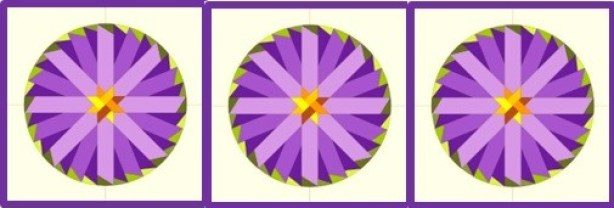
An original quilt block inspired by the lovely Aster flower…
The Aster is another original 18″ Quilt block with an inset 15″ circle flower, designed by me for the Dreamcatcher Quilt.
I have always loved the Aster-such a pretty flower, which is also the Birth Flower for September! Did you know it gets its name from Greek, meaning ‘star’, because the flowers resemble stars? In Greek mythology, it became a symbol of love when it was placed on the altars for the Gods. I included it as the eleventh block in the DreamcatcherRound the Year quilt…to coincide with Valentine’s Day in my Block of the Month Quilt. Asters also symbolize wisdom, faith, colour, besides patience, daintiness and charm.
My Aster comes in blue-the blue blooms are not only rare but also extremely lovely-the colour ranging from a light through deep blue to purples. The block is really easy to piece and comes up very quickly. To make it more challenging, I added y-seams to the centre. Of course, you could applique a simple circle as the centre, or try out any of these options!
The printable PDF files instructions and templates for the block are now available on my MadsPatch store on Ecwid.
Four shades of the main colour (blue) totalling about 1/3 yard and small scraps of yellow, gold, light and deep orange – are used here. My Aster is blue to go with Dreamcatcher Quilt, but you could make yours in any of these colours -pink, purple, red or yellow.
Please note that this in a digital pattern, you will receive only a link to download the .PDF files on your computer/device. A paper pattern WILL NOT be snail-mailed to you. The links expire in 72 hours, so you would be well-advised to download the files on a permanent location on your PC/ Mac / Notepad asap.
You need Adobe Acrobat Reader Software, downloadable for free at the Adobe site, to read the files. Print from the saved files; do not print directly from the mail/ link. The patterns are designed for printing on A4 size paper, but letter size 8.5″ x 11.5″ will be fine. Set your printer to ‘Actual Size’ or 100% setting before printing.
All patterns are for your personal use only. Please do not share with others or use for teaching/ workshops etc without my prior permission! The 4 files will include:
Instructions File – contains these instructions including the fabric requirement, piecing order and Master Template to be used as a guide for assembling the block.
FPP Templates File containing foundation paper piecing templates.
Master Template that will help you in assembling the block – remember this is is a mirror image. You can also try out your own colours on the outline block.
Bonus: I also include a bonus file with the pattern, these are tips for paper-piecing you can print and keep with you always!
So what do you plan to make your Aster Block into? A round Christmas table runner?
Like every other quilter, I also always had Mariner’s Compass on my bucket list!
So, when I was designing the DreamcatcherRound the Year , I included it as the seventh block in the quilt, albeit a little different.
This off-centre Mariner’s Compass is a variation of the block, which is traditionally hand pieced or English paper pieced. However, this pattern employs a number of techniques, including foundation paper piecing, machine piecing and appliqué. It finishes at 18″ square, with a 15″ pieced circle.
The printable PDF files instructions and templates for the block are now available on my MadsPatch store on Ecwid.
This is the Dusk colourway, the rays of the setting sun lighting up the needles on the right, as the darkness gathers from the East on the left. The name of the block came about as the pattern originally had a circle of geese , receding in size, flying upwards from both sides – I dropped them to simplify the design.
Fabric Requirement
Fabric Colour Code – Block Seven Southward Bound
Four shades of the main colour (blue) and four in a contrast colour way – yellow, gold, light and deep orange – are used here.
The fabric requirements given in my pattern are quite generous (according to me!), but you may want to cut fabric as you go along.
Please note that this in a digital purchase of a pattern, you will receive only a link to download the .PDF files on your computer/device. A paper pattern WILL NOT be mailed to you.
2. On purchase, you will immediately receive a mail confirming receipt of the order, followed by a second mail with download links. If you do not see the mails in your inbox, please check your Spam folder. Please do not click the links repeatedly as each click is treated as a download and number of downloads is limited.
3. It is advisable to access the files on your laptop or notepad where you can save them, rather than on your smartphone.
The links expire in 72 hours, so you would be well-advised to download the files on a permanent location on your PC/ Mac / Notepad asap.
4. You will need to download the software Adobe Acrobat Reader (free)at Adobe site to be able read the files.
5. Download the files on your device/ computer; do not print directly from the mail/ link. The patterns are designed for printing on A4 size paper, but letter size 8.5″ x 11.5″ will be fine. Set your printer to ‘Actual Size’ or 100 % setting before printing.
All patterns are for your, the buyer’s personal use only. Please do not share with others or use for teaching/ workshops etc without my prior permission! The files will include:
Instructions File – contains these instructions including the fabric requirement, piecing order and Master Template to be used as a guide for assembling the block.
Template File.1 containing paper piecing templates A to P . Print at actual size or 100% in portrait mode
Template File.2 containing templates Q to X and Z . I suggest you print these on freezer paper, if available, at 100% or actual size. These are odd shaped pieces with circular edges, and I personally like to use freezer paper for accuracy for cutting these.
Master Template
This diagram is the Master Template that will help you in assembling the block – remember this is is a mirror image. It is also included with the files. You can also try out your own colours on it.
Printing and Templates
I printed the templates on Freezer Paper.
If you don’t have freezer paper printer sheets, what do you do? Cut the freezer paper to your regular printer paper size (A4 or letter – approximately 8.5″ x 11″). Iron just the edges of the freezer paper (about ¼”) to a regular printer sheet, so that they are joined evenly, without any creases. Print as usual, taking care to insert the joined sheets in the printer so that the printing is on the freezer paper.
Place freezer paper, sticky side down on regular printer sheet. Iron about a 1/4″ on all edges. Print the double sheet as usual.
Piecing
The block is partly foundation paper pieced. I have blogged about the paper piecing patterns for this quilt earlier, and also given a few paper piecing tips here. In case you are too lazy to go through those ( I would be, I know!) here is a quick checklist before you begin! I also include a bonus with the pattern, these tips in a file you can print and keep with you always!
Paper Piecing Checklist
Have the fabrics been colour coded?
Has the machine stitch length been reduced?
Are the templates in order specified in the instructions?
Have you picked up the correct fabric pieces or strip/s? The fabric code number is printed on each piece position. It is a good idea to check that once in a while.
When you start, is your piece #1 placed on position #1 on the templates?
Is the wrong side of the fabric piece touching the paper?
Is the incoming piece placed right sides touching the previous one?
If strip chain piecing the templates, have you sufficient space between one template and the next?
Once done with the piecing, and before you start assembly, you may like to refer to this checklist!
TemplateAssembly Checklist
Have you a print out of the Master Template in front of you?
Avoid removing paper pieces before your template is ready to actually go under the machine! Arrange the templates, printed side up, using the Master Template as a guide.
If you do remove the paper, ensure you have the template (alphabet) name pinned to wrong side of the pieced template, to guide you during assembly.
At all times, keep the printed/ wrong side up, pick up the templates to be assembled, (remove the paper, if you wish to) sew them together. Put back in place, wrong side up. Go on to the next. At all times, remember to keep track of template names
Refer to the Master template at all times during assembly to ensure all is in order! Reminder: If you take off the paper before assembly, remember to stick a post-it note or pin a piece of paper with the template name on the pieced template.
Before I sign off, here is a look at the Rainbow version of the block. The templates and instructions are available my Ecwid online store, Madspatch.




You must be logged in to post a comment.