The (Almost) Fractal Mandala – Block Fourteen, Dreamcatcher Round the Year Quilt

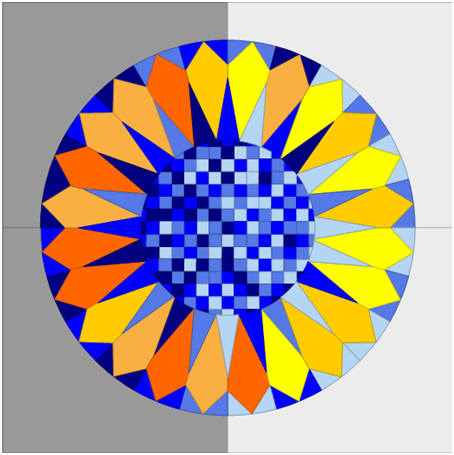
I started designing Block Fourteen as a tribute to the  Dear Jane quilt. I experimented with a number of the Dear Jane triangular blocks, placing them revolving around a centre point to make a circle. This design came about when I was playing (on the free Quilt Assistant software ) with the block where flying geese fly outwards. I immediately fell in love with it! It does have a hypnotic quality to it, like a Mandala you can meditate upon. Also, if you take each of those wedges and subtract the outer level, the design remains the same. So, I have been trying ( in vain) to convince the few mathematicians whom I know, that this pattern a fractal! As a concession to them, I call this the (Almost) Fractal Mandala.

And so, I present to you, Block 14 of the Round the Year Block of the Month Quilt, the (Almost) Fractal Mandala!

Much to my chagrin, I discovered after I had made the block, that a similar block ( I do not know the name) already exists! I am still very proud of it, because I discovered my Mount Everest on my own, and climbed it too! So there!

Block 14 ( Almost) Fractal Mandala, Round the Year Quilt

The block, like all other blocks of the BOM quilt, is designed as a 15″ circle inset in an 18.5″ ( unfinished) square. It is a deceptively easy block to piece, hence not too many photos accompany this post.

The templates and instructions can be downloaded from the links at the end of this post. You can find the links to patterns for all the other blocks of this quilt on the Dreamcatcher Round the Year Quilt Page ( click on the link above).

The brilliant Tina Katwal, one of the pioneer quilters from India, took out time from her busy schedule to test this block and you have to thank her, that you do not struggle with stingy fabric requirements!

Fabric Requirement

The Dusk colourway uses 4 shades of blue and 4 fabrics in a contrasting yellow to orange range. I suggest you use use solids or very small prints combined with solids to best highlight the design element of the block. I have used Fossil Fern by Benartex for mine.

Fabric Code Block 14 Almost Fractal Mandala

This is a great block for using any scraps/ strips of various sizes and shapes left over from the previous blocks. Nevertheless, I have tried to give some kind of estimate of the fabric requirement.

Please spray starch and press all your fabric before cutting!

Fabric Colour

Code

Fabric needed
 

Orange

4

2.5″ x 32″
 

Gold

5

4″ x 19″
 

Light Orange

6

3.5″ x 14″
 

Yellow

7

3.5″ x18″
 

Light Blue

1

4.5″ square
20″ x 12.5″ strip
 

Medium Blue

2

3″ WOF strip +
strips 8″ -10″of various widths 1.75 to 2.5″
 

Deepest Blue

3

3″ WOF strip
strips 8-10″ of various widths 1.75 to 2.5″
 

Medium-Deep Blue

8

4.5″ square

 Cutting Instructions

I suggest you label your fabric so that you do not get confused as you cut so many strips. An easy way to do this is sticking a piece of freezer paper with the code on it on the strip!

For ease in piecing, you can cut and sort your fabric template wise as follows:

Fabric Code ABCD EFGH IJKL MNOP QRST UVWX
4 Orange   For diamonds 2 strips 2.5″ x 16″        
5 Gold   4 HSTs 3.5″ For diamonds 2 strips 2″ x 12″      
6 Light Orange 4 HSTs 3.5″ 4 HSTs 3.5″        
7 Yellow 4 HSTs 3.5″     2 strips 1.75″ x 11″ for diamonds    
1 Light blue         4QSTs from 4.5″ square 20″ x 12.5″
2 Medium blue 3″ x 19″ 4HSTs 3″ 4HSTs 3″ 4HSTs 2.5″ 4HSTs 2.0″    4HSTs 1.75″ 4QSTs 3″  
3 Deepest blue 3″ x 19″ 4 HSTs 3″ 4HSTs 3″ 4HSTs 2.5″ 4HSTs 2.0″ 4HSTs 1.75″ 4QSTs 3″  
8 Medium to deep blue         4QSTs from 4.5″ square  

While I pieced with strips, I thought it would have made life much simpler had I cut the diamonds earlier. Note that the two sets of diamonds on each template face opposite directions, hence the 2 strips in the cutting instructions for the diamonds. Here is my fabric for the block, all cut and sorted.

Fabric cut and sorted out

  Templates

1. Print the templates with your printer settings at 100% (or actual size).

2. Templates A to H are given in two parts each, with instructions to glue them. You could also piece these separately and then join at the centre seams. I have done that for the first two sets of templates, ABCD and EFGH.

3. Glue together the two parts of background Template U on the edge indicated. Use this to cut 4 identical pieces for U, V, W and X and put aside.

Piecing Instructions

I suggest piecing alphabetically,that is first on the larger templates at circle edge. You can use scraps from the larger pieces on the smaller templates inside! Piece in the following order:

– A, B, C and D

– E, F, G and H

– I, J, K and L

– M, N, O and P

– Q, R, S and T

Templates A, B, C and D had been printed on freezer paper, without gluing on the centre line as indicated In the templates. Cutting the wedges became as simple as this…

You could also use ordinary paper printed templates...
You could also use ordinary paper printed templates…

All I had to do was to add the triangles on the wedges. (If you have glued your templates A,B, C and D between pieces #3 and #4, plese do not get confused by these photos!)

You can glue the two halves of the templates togeteher and piece them in one go!

E, F, G and H were (each) also pieced in halves without gluing in the centre, and sewn together on the centre later, just before assembly.

E, F, G and H pieced in halves...
E, F, G and H pieced in halves…you can glue the templates at centre between piece# 3 and #4 and piece these as  single units!


For the rest of the templates, I pieced with strips, like I said, placing the strips perpendicular to each other as I went along.

Place the strip for the diiamond at right angles to the previous strip and sew on seam line
Covering the diamond...
Covering the diamond…

Block 14 Almost Fractal Mandala, Round the Year QuiltBlock 14 Almost Fractal Mandala, Round the Year Quilt

A triangular piece comes in next, note, in the upcoming photo, that the blue strip was placed straight along the template for this seam between piece #3 and #4. This is followed by another diamond strip at right angles to the template. Use the other diamond strip for this!

Note the blue strip for piece#4 is placed straight along template. The diamond yellow is again at right angles

After that diamond, there is only one more blue triangle to add and we are done!

Similarly, piece all the templates, I to P. Once you get the hang of it, it comes up really fast!

I did not take too many pics, but here are a couple of photos of the centre templates Q, R, S and T being pieced!

Templates Q, R, S and T ready for piecing...
Templates Q, R, S and T ready for chain piecing…
and done except for the corners ... fast work!
…and done, except for the corners! Fast work!

The scraps from the previous templates come in useful for the corners of the centre templates!

Assembly Instructions

Use the Master Template (mirror image) as a guide to assembly. The Instructions file also contains a coloured mirror image guide.

I removed the paper before assembly.

The Master Template is a mirror image! Left is right and right is left!

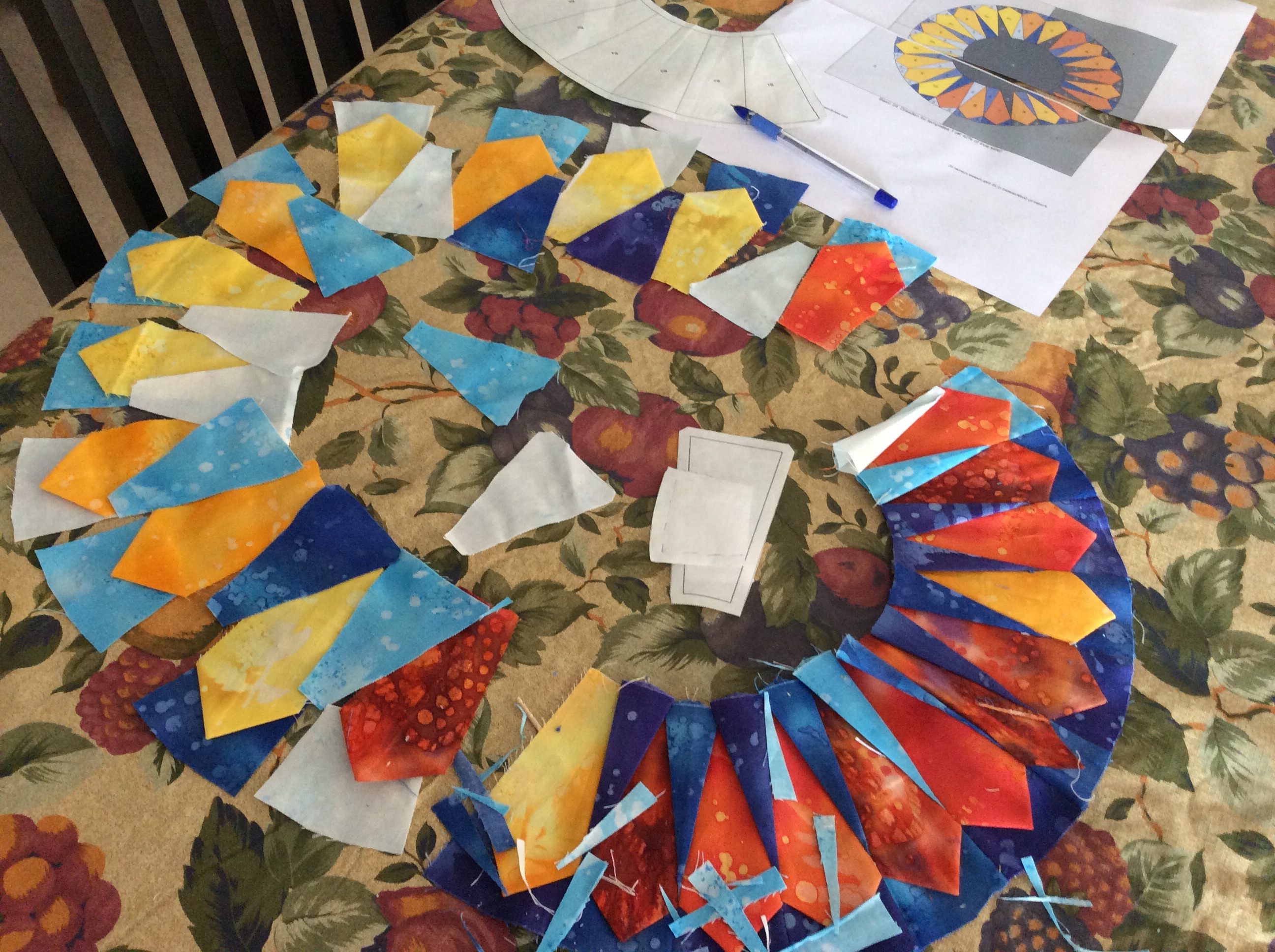
Assemble the block in quadrants. But before you begin, lay them all together to see if all is in order, and of course, to admire!

I love this! Piecing finished in one evening!

( First, I sewed the respective template halves A to H. If you glued your templates before piecing you will not need to do this. )

I am ready for assembly now! I joined the outermost two templates A to E; B to F; C to G and D to H, and put them aside. (as I did not want to risk the wedges on the A, B, C and D templates getting misshapen.)

The rest of the templates, I joined from centre outwards. ( All templates at each ‘level’ are similar so it really does not matter whether you pick up M or N to join to Q, R, S or T!)

Here is the finished circle, from the back. Note that seams on adjoining quadrants are pressed in opposite directions, so that they interlock.

As far as possible, press adjoining seams in opposite directions to interlock them when sewing ... ensures sharper corners!
As far as possible, press adjoining seams in opposite directions to interlock them when sewing … ensures sharper corners!

5. Done ! Now join the background. You can join the individual quadrants to the background pieces U, V, W and X and then join the 4 squares together to form the 18.5″ square.

I am not joining any of the circles to the background till all of them are done.

We begin putting the quilt top together in May, after the final sixteenth block comes up on 1st May.

Block 15 will be posted only on 16th April 2015 as I am travelling and am otherwise busy, so you have plenty of time to catch up, if you began late or are straggling behind on the blocks.

Meanwhile, do put in a comment if you like this block and are doing this quilt… and make my day! Please write in if you have a problem with the instructions, or if you discover a better way of piecing my blocks.

I would also love to see your blocks posted on my Facebook page Patchwork of My Life.

Okay, so we are all done here, except for one important thing, the block pattern and instructions! You need Adobe Acrobat on your computer ( available for free download) to be able to view these files.

1.Block 14 Fractal Mandala Instructions

2.Block 14 Fractal Mandala Templates

Please note that the downloadable patterns with paper piecing templates and instruction files for the Dreamcatcher Round the Year quilt blocks are being migrated to my store MadsPatch and will not be available for download for free from 15th November 2020 onwards.

Feathered Star , Block Thirteen of the Dreamcatcher Round the Year Quilt

Block 13 Feathered Star

The Feathered Star

is one of the prettiest traditional star blocks. It looks deceptively difficult to piece, but comes together beautifully, everything falling in place just so! While drafting it for Block 13 in the Round the Year Quilt, I could avoid the ‘y’ seam altogether by a small change in the paper piecing pattern, making it easier still! Like all other blocks of this block of the month quilt, this also is drafted as a 15″ paper pieced circle and set in an 18″ (finished) square.

The templates and the Instructions for the Blocks can be downloaded from the links at the end of this post. You can access the patterns for the other blocks of this quilt from links on this page.

There are two template files, one containing the paper piecing templates. You may also wish to download individual templates for the background and other pieces , I worked with strips and rectangles.

Print the Templates Files with your printer settings on 100% or actual size, in portrait mode. One way to check if your templates are printing correctly is to check if the ¼” seam allowance is correct! Check that on a straight edge, not on a corner or a curve! 

Cut out the templates.

Print the Instructions File and keep at hand; you can refer to this blogpost for step by step instructions with pictures.

 Fabric Requirement

For the block in the Dusk Colourway, I have used 3 shades of blue ( other than the background) and 4 contrasting colours in the yellow-to- orange range.

I suggest you pin a slip of paper with the fabric code on your chosen fabrics. You could also press a small scrap of freezer paper with the code on the fabric. I also recommend starching your fabric crisply before cutting it.

Fabric Coding for the Feathered Star


Fabric

Fabric Code

Background*

Star

Feathers

Wedges*

Total pieces in block
Light blue 3 3 rectangles 10″ x 6″ 3
Light-medium blue 2 2.5″ x 10″ 2″ x 20″ (2 strips) 3.5″ x 20″ 27
Medium blue 4 2″ x 20″ (2 strips) 3.5″ x 20″ 30
Deep blue 1 3 rectangles 10″ x 6″ 2.5″ x 10″ 6
Yellow 8 1.75″ x 14″ 6
Gold 5 2″ x 20″ (4 strips) 42
Light orange 7 3″ x 15″ 6
Deep orange 6 3″ x 15″ 6

* Cutting Instructions

NOTE: I have italicized the names of the templates after `Z’, to avoid confusion. 

Background (Optional)

Use Templates AK, AL and AM (from the Individual templates File) to cut background in fabric#3. Label and keep aside.

Now use same Templates to cut Fabric#1 background rectangles, labeling them AN, AO and AP respectively.

You may want to appliqué the completed circle on the square. In this case, the option is to join the longer sides of two rectangles measuring 9.75″ x 19″ in fabrics #3 and #1 to make a square 19″ and put away till your circle is pieced.

Wedges

Cut as follows –

From the strip 3.5″ x 20″ of Fabric#2 cut and label as follows

3 pieces using Template AI for AI, Y and AA

3 pieces using Template AJ for AJ, Z and AB

From the strip 3.5″ x 20″ of Fabric#4 cut and label as follows

3 pieces using Template AI for AG, AC, AE ( Note – AI is identical to AG)

3 pieces using Template AJ for AH, AD, AF ( Note – AJ is identical to AH)

This is how I cut the wedges. I traced my templates AI and AJ on freezer paper.

I layered the two 3.5″ x 20″ strips of fabric #2 and #4, both wrong sides up. I pressed the freezer paper templates on the wrong side and cut the strips as shown in the pic below. If you do not have freezer paper, simply pin plain paper templates on the strips!

Cutting the wedges. Remember to keep the wrong side of the fabric UP when using printed templates which are mirror images!

Piecing Instructions

I like to sort the templates according to the shape and then colour coding ( if possible) for maximum efficiency and least confusion, before I start my piecing. This makes chain piecing simpler too, as the fabric can be stacked in piles in the correct order, accordingly.

General tips on paper piecing for these blocks have been given in this blogpost.

Piecing the Star

Strip chain piece the inner star in 4 lots .:

A, I and Q

E, M and U

B, J and R

F, N and V


Piecing the feathers

Sort the templates in 4 lots as follows.

C, G and W

D, H and X

K, O and S

L, P and T.

Note – I have provided an individual template for the diamond at the corner of the feathers. You may like to cut 6 diamonds and keep them aside before you start piecing the feathers.

After experimenting with strip chain piecing and rectangles, I tried the following method, which I found to be most efficient way to piece the feather row.

Trim the previous piece ¼” beyond seam line. Line up incoming strip parallel to the template. Sew on the seam line.

For sewing triangles facing opposite diections, line up the incoming strip so…


… as viewed from the printed paper side. Sew on seamline.

Open the strip. It will lie at an angle to the template.

The opened up strip covers the entire equal-sided triangle.

( This does not work with any triangles other than those where all three sides are equal, as in this case.)

Now trim the strip at the edge of the template. The triangular piece is fully covered …and a seam allowance is also available!

Trim along the paper edge! Simple!

As viewed from the right side:

Once you get the hang of it, the piecing is quick!

Add the next strip as before.

It is better to work simultaneously on templates from each of the lots, as the direction of the ‘slant'( after cutting ) will alternate with each seam. The strips can be switched around accordingly.

Caution: When you reach the diamond ( piece #7) towards the end of templates D, H, L, P…etc, trim the strip after only covering the full diamond piece. As mentioned earlier, I have also provided an individual template for cutting the diamond pieces. You can use these ( instead of strips) when you reach this step.

Once the feathered rows are done, we are ready to assemble the block.

After the problems I had with Block Twelve, I `mock assemble’ the block at every stage to ensure all is proceeding well.

Assembly Instructions

This Master Template is used as a guide to assembly. Remember, it is a mirror image of the final block, which means it shows the block from the back (printed paper) side.


Step 1: Assembling the inner star ‘points’

Join A to B; I to J; Q to R;

Sew E to F; M to N and U to V.

Removing the paper makes this step easier, as the seams can be ‘locked’.


End of Step 1:

You end up with 6 pieced diamonds which will make up the inner star.

The inner unfeathered star

Step 2: Feathering the wedges

Sort the templates shapewise and then colourwise and sew the feather rows to the respective wedges. Just remember, the colour on the feathers and the wedges should be the same!

First the shorter feathered rows to the `blunt-edged’ wedges!

Sew W to AI ; C to Y; G to AA.

Sew K to AC; O to AE and S to AG

First join the feathers to the outer wedges.,,here are the blunt wedges joined to the ‘short’ feathers
Block 13 Feathered Star Assembly
The ‘blunt’ wedges with the ‘short’ feathers

Now the ‘pointy’ wedges to the longer feathered rows (with the diamonds)

Sew D to Z ; H to AB; X to AJ

Sew L to AD; P to AF and T to AH.

Block 13 Feathered Star Assembly
The ‘pointy’ wedges get their feathers ( with a diamond)…

Here they are, all done! Did I tell you it is very important to press after each step?

Almost done!


..as is to arrange them again as per the final design to ensure there is no mix up anywhere!?

Step 3 : Joining the feathered wedges to the inner star ‘diamond shapes’

We are almost there, ready to give the inner star its feathers.

Sew AB to CY; EF to G.AA ; UV to W.AI

Sew IJ to K.AC; MN to O.AE and QR to S.AG

Block 13 Feathered Star

These look a mess! But just one more step and…


Step 4

I again arrange the templates assembled so far to ensure all is going well.

I am down to the last step that I will be doing for now!


Join ABCY to DZ; EFG.AA to H.AB; UVW.AI to X.AJ

IJK.AC to L.AD; MNO.AE to P.AF; QRS.AG to T.AH


And I am done!!

Twinkle , twinkle feathered star!


Our 6 star wedges are ready.

Final Assembly

This is a step I am skipping for now.

You could join the 6 wedges to complete your circle and appliqué it to 19″ square. Trim to 18.5″ after the appliqué.

Block 13 Feathered Star Assembly
Assemble the six wedges to complete your feathered star in a circle and applique to piced square

OR

Join to background pieces as follows, (referring to the star centre) before finally joining them:

Wedge with U to AK; wedge with A to AL; wedge with E to AM; wedge with I to AN; wedge with M to AO; wedge with Q to AP.

Block 13 Feathered Star Assembly

Block 13 Feathered Star Assembly
Join individual wedges to background pieces …

Join these along the straight lines follwing the Master Template to obtain your feathered star!

Some people have asked for the Master Template in colour.

Block 13 Feathered Star
This is a mirror image, what is on the right (in the block front )appears on the left and vice versa. The number in brackets stands for the Fabric Code.

Don’t forget to share your Feathered Star on my Facebook Page Patchwork of My Life! Click on the link on the right to like my page and gain access to it.

I must not forget to mention Prabha Mathew who tested the block for me and pointed out some errors in the original pattern, which I have tried to take care of! Thank you so much, Prabha 🙂

Have fun!

1. Block 13 Feathered Star Instructions including Fabric Requirement and Master Template

2, Block 13 Feathered star Paper piecing Templates Revised

3. Block 13 Feathered star Individual templates

Please note that the downloadable patterns with paper piecing templates and instruction files for the Dreamcatcher Round the Year quilt blocks are being migrated to my store MadsPatch and will not be available for download for free from 15th November 2020 onwards.

Block Twelve Dozens Squared, Dreamcatcher Round the Year Quilt

This is a block that has given me much heartache , and that story deserves its very own blogpost! Meanwhile, here it is, Dozens Squared, the twelfth block of the Round the Year Block of the Month Quilt.

Block Twelve Dozens Squared, Round the Year Quilt BOM (Rainbow)

The block finishes at 18.5″ square (including seam allowance), with a 15″ inset circle. It is partly paper foundation pieced; the templates and instructions  can be downloaded in PDF format from the links at the end of this post.

What’s in a name?

This Block 12 of the Round the Year BOM Quilt is inspired by the beautiful Jack’s Chain block. I couldn’t decide what I wanted to call it. I thought of something to do with 9-patches and then Jill’s Chain! But then I counted the number of pieces in the circle – 144. It could not be chance that Block Twelve should contain twelve twelves, could it? The name would have to to have some reference to this, I thought. No way I was going to call it ` Gross’, which is the correct nomenclature for a dozen dozens! Dozens Squared sounded better, also as the dozens would in any case be inset in a square!

Fabric Requirement

The fabric requirement for the block is given for the Dusk colourway. I have scrapped the block that I made in the Dusk colours (not this) – I thought it looked quite ugly (gross?)!

Block Twelve Dozens Squared, Round the Year Quilt – Dusk – Fabric Code
Fabric Colour

Fabric Code

Background

Nine patches

Centre

Spiked wedges

Circle edge wedges

Lightest blue

1

19″ square OR
10.5″ x 25″
Two 6″ squares 2.25″ x 8″    
Medium Blue

4

  Two 6″ squares 2.25″ x 8″   Two 2″ x 8″
Medium-dark blue

3

  Two 6″ squares 2.25″ x 8″   Two 2″ x 8″
Deep blue

2

    2.25″ x 20″ 2.5″ x 36
2.0″ x 36″
Two 2″ x 8″
Yellow

8

    2.25″ x 6″    
Gold

6

      2.5″ x 12″
2″ x 12″
 
Light Orange

7

      2.5″ x 12″
2″ x 12″
 
Orange

5

      2.5″ x 12″
2″ x 12″
 

Please refer to the downloadable Instructions File, if you want detailed cutting instructions!

Printing Instructions

Please remember to print the Templates file with your printer
setting at 100% or Actual size in portrait mode. Cut out the paper piecing Templates.

I recommend printing also the Instructions file and keeping the Master Template (provided in the Instructions File) at hand when assembling the block. A line drawing version of the Master Template is also included in the file (also a mirror image ). You can use colour pencils to experiment with your own colour combinations!

Piecing Instructions

The Nine-Patches Quick Method

Piece the six 9-patches A, B, C, D, E and F using the quick 9-patch method. The pictures I am showing here are for the rainbow block. You will start with 3 pairs of 6 inch squares.

For the Dusk version, team upthe squares in 3 pairs.
For the Dusk version, team up the squares in 3 pairs.


Note that we do not measure 2" from edge, but 1.75" from seamline!
Note that we do not measure 2″ from edge, but 1.75″ from seamline!


Similarly from the other seam!


Quick NIne Patch Square
Sew to get two strip sets. Press to darker side – I chose blue here.


Quick Nine Patch Square
If you are doing the Dusk version, you would already be working with 6″ squares. This would be irrelevant!


Quick 9 patch squares
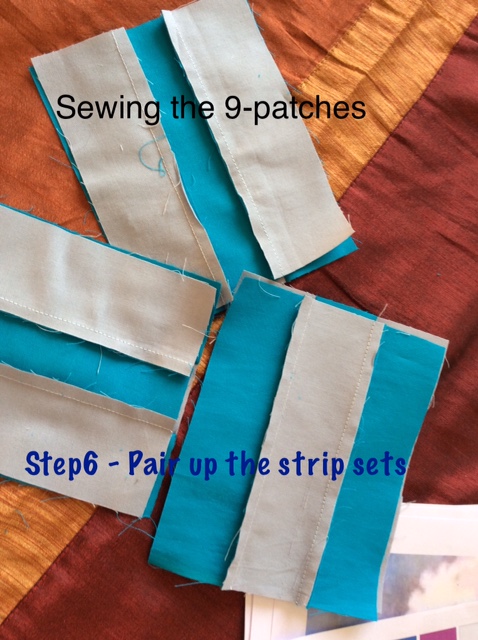
Pair up the strip sets. Careful! Check you have the right pairing!


Sew on the shorter sides.


Quick 9 patch squares
Cut 1.75″ from both the seams…


Quick 9-patche squares
…and sew the centre strip to the double strip sets from the sides

For the block we need 9-patches which finish at 3.5″, so we will need to trim these to 4″,  with centre square remaining at 1.5″.

Quick 9-patch
Mark the centre ( of the centre square!) and trim to 2″ from it on all sides.

You could also use the template A to match and trim the 9-patches to size.

Quick 9 -patch squares
Done!

Piecing the Centre

I would suggest cutting the strips into triangles before you start piecing. Lay the 60 degree line in alternating directions as you cut the triangles – remember to leave 1/4″ on the top before you cut in the opposite direction.

Block Twelve Dozens Squared, Round the Year Quilt
I used strips left over from previous blocks;  in paper piecing, one need not be accurate in cutting! The next set of triangles will be cut by changing the ruler direction.

If doing the Rainbow block, I may mention that a 6″ x 2.25″ yields 3 traingles quite comfortably. I used 8 different colours for the centre.

The pieced centre triangle templates from the Dusk block

In no time, you would have the templates S, T, U, V, W and Xpieced. Put these aside.

Spiked Wedges

Now we come to the 12 spiked wedges G, H, I…Q, R.

Each of these wedges has 5 pieces. Before you start the actual piecing, I suggest you pin pieces # 1  (2.5″ x  1.5″) and #2 (HST 2.5″) on all the templates. This helps save time in sorting colours and sizes of the upcoming pieces!

IMG_1648

Block 12 Dozens Squared

Chain piecing must be the greatest innovation in sewing, don’t you think? In no time we are ready for piece#3, (which is the largest piece, at 2″ x 4″)

Align the corner of the rectangle to the busiest corner on the template!


Note the angle and placement of the piece.
Note the angle and placement of the rectangular piece. It should completely cover the area under Section #3 when opened out.

Trim the excess seam allowance.

Step 2 continued... trim to seam allowance!
Step 2 continued… I like to trim to upcoming seam allowance – 1/4″ beyond the seamline!

Press open. Piece #4 is easy! Just align the long edges of the two pieces and sew!

I like to trim the just stitched piece to just 1/4" beyond the upcoming seam line!
Add piece #4

Chain piecing, as usual!

Piece#4 chained in place

Block 12 Dozens Squared

We are ready for the last step – sewing piece #5 – a rectangle 2″ x 2.5″ ( I used 1.5″ x 2.5″ rectangles, but they made a tight fit, so I have changed the width to 2″.) Again, please check the rectangle placement before sewing to ensure you have the paper section fully covered.

IMG_1698

All our piecing is done, all that remains is the assembly!

Assembly Instructions

Assemble the block, using the Master Template as a guide. Remember, the Master Template is a mirror image and shows the block as it would look from the printed paper (reverse) side. As seen here, what is on left appears on right and vice versa.

1. Sew the spiked wedge (halves) to either side of the respective 9-patches.

Sew G and J to opposite sides of A; M and P to opposite sides of C; H and K to opposite sides of E;

Sew N and Q to opposite sides of B; I and L to opposite sides of D; O and R to opposite sides of F.

2. Sew the centre pieced triangles to the 9-patch template sets.

Sew S to GAJ; V to MCP; T to HEK; W to NBQ; U to IDL and X to OFR.

3. Sew the respective circle edge wedges to the just assembled template sets. Here is some auditioning of fabric for the circle edges…

Block 12 Dozzens Squared Round the Year Block 12 Dozzens Squared Round the Year Block 12 Dozzens Squared Round the Year Block 12 Dozzens Squared Round the Year

…before I settle on this!

Block 12 Dozzens Squared Round the Year

Final Assembly

Option 1


Join background pieces AE1/ AH1 to wedge set containing A and B;

Join the background pieces  AF1/AI1 to wedge set containing F and E;

Join background pieces  AG1/AJ1 to wedge set containing D and C.

Join in threes – pieced set AE1, AF1 and AG1 to form one half; and the other 3 pieced sets to form the other half

Join the two halves to form the full block.

Option 2

Join the pieced sets to form the full circle and appliqué it to the background square using your favourite method.

Trim to 18.5″ square.

Here is a look at the Dusk version of the Dozens Squared block


Dreamcatcher Block 12
Patchworkofmylife

Please note that the downloadable patterns with paper piecing templates and instruction files for the Dreamcatcher Round the Year quilt blocks have been migrated to my store MadsPatch and are not be available for download for free from 15th November 2020 onwards.

Blue Aster – Block Eleven of the Dreamcatcher Round the Year Quilt

Blue Aster Quilt Block Round the Year Quilt Block 11The Blue Aster is Block 11 of the Dreamcatcher Round the Year Quilt. The 15″ pieced circle is inset in an 18″ ( finished) square.

The foundation paper pieced block is very quick to piece. The centre introduces inset or y seams for the first time in this BOM.  The block was tested for me by the lovely Anuradha Ramesh, who also tested the Sapphire Fire block!

If you want the patterns of the previous ten blocks of this quilt, you can find all the links on my MadsPatch Ecwid Store. The Templates and Instructions for this block can be downloaded in printable pdf format from the links  at the end of this post.

BUY THE PATTERN

Fabric Requirement

In the Dusk colourway, the block uses 4 shades of blue for the petals besides some small scraps of yellows and oranges.

Fabric Coding for Blue Aster

Fabric For Petals For Centre ( pieces# 3 & 4on I to L) For Edges
Light Blue

1

2.25″ x 7.5″ ( 8 pieces)
Medium Light Blue

2

2.25″x 6.5″ ( 8 pieces)
Medium Dark Blue

3

2.5″x 7.5″ ( 4 pieces)
Deep Blue

4

2.5″x 6.5″ ( 4 pieces)
Deep Orange

5

1.75″ x 5″ 1.75″ x 2.5″ ( 8 pieces)
Light Orange

7

1.75″ x 5″ 1.75″ x 2.5″ ( 8 pieces)
Gold

8

1.75″ x 5″ 1.75″ x 2.5″ ( 8 pieces)
Yellow

6

1.75″ x 5″ 1.75″ x 2.5″ ( 8 pieces)

 Printing Instructions

  1. Print the Templates File with your printer settings at 100% or actual size in portrait mode.
  2. Print and keep a copy of the Instructions File for ready reference.
  3. Cut out the paper piecing templates.

Piecing and Assembly Instructions

1. Follow the step by step Instructions for best utilization of your fabric to piece templates A to H.

2. Piece templates I to L

The Master Template is a mirror image – the paper pieced block from the printed paper side!

3. Follow the Master template to join the templates as follows:

Join A to B; Join C to D; Join E to F; Join G to H. You can press seams open to reduce bulk. (I originally did, but then sewed a couple of them to one side with the next seam. I think I  will never be able to sew with seams pressed open!)

We now encounter inset ot `y’ seams at the next step. You may refer to the step by step instructions if you are uncertain how to proceed.

Begin at the pointed end of the wedges, leaving ¼” for insetting seam to join AB to I at A1 ; join CD to J At C1, join EF to K at E1 and join GH to L at G1.

Now match the seams at the centre and join IAB to JCD.

Similarly, join KEF to LGH.

Finally join the two halves to make your full flower.

Applique the circle to an 18.5″ background square to complete your full block 11, Blue Aster. I recommend taking a larger square and trimming it to size.

BUY THE ASTER PATTERN HERE

 Step by Step Instructions

For general tips on paper piecing for the blocks in this BOM, you can look at this post I published some time back.

It is a good idea to pin when handling large or unwieldy fabric pieces!

Pin the Fabric#1 strips on the templates I, J, K and L and keep aside.

You may have noticed that we cut only 4 pieces  of the medium and dark blue fabric, whereas they are used in 8 places each! One thing I hate about paper piecing is the amount of fabric one wastes. So, this is how I found a way out, without complicating the cutting instructions!

We `prepare’ templates A to H for piecing.

Pin the rectangular piece of Fabric#3 on piece A1, C1, E1 and G1, aligning one long edge of the fabric ¼” beyond seamline between piece#1 and #3 on the template(s).

Pin for 1/4″ seam, letting the excess fabric hang out

Trim the excess fabric piece.

The excess fabric is trimmed away …

Pin the excess pieces of fabric at piece#1 on templates B, D, F and H.

… and used on the other 4 templates!

Fold the template at seam line between pieces # 1 and #2 on all the templates A to H and trim the fabric beyond the seam line towards circular edge (adding ¼” seam allowance).

I have discovered that trimming to the seam allowance BEFORE piecing makes life easier!

We are ready to start piecing templates A to H. Remember the wrong side of the fabric should touch the paper. Also, travel ¼” beyond the seam line when piecing.

Initially, I used strips of the yellow- orange fabrics to piece the small wedge to the `petals’, but later concluded that piecing with the 1.75″ x 2.5″ rectangles was more efficient and facilitated chain piecing. I am not giving a picture so that I can avoid confusion!

Chain piece all templates A to H up to piece #4.

Add the fifth piece only to templates A , C, E and G, aligning one edge of the fabric as we did for piece #1.

Now fold back the paper on the incoming seam line like in the picture below. Do not worry about the paper getting torn at the seam.

Using one rectangle to piece two long triangles!

Trim, allowing for a ¼” seam.

Don’t throw away that trimming!

This excess fabric piece will be used for piece#5 on templates B,D, F and H.

Use it here!

Add piece#6 on all the templates A to H. With this, templates B, D, F and H are pieced and can be kept aside. Proceed to finish piecing templates A, C , E and G; and I to J.

When piecing I to J templates: first sew the respective 1.75″ x 5″ strip at piece #3 on each of the templates. Trim off and keep the excess fabric piece for sewing at place#4 on the other templates as required. 

TThis block is perhaps the quickest to cut and piece!

 Assembly Instructions

Flip the pieced templates to the printed side and arrange the templates using the Master Template as a guide.

Pin templates A to B; C to D; E to F and G to H, taking care to ensure you have the right edges together…

Ensure you have the correct edges together!

…and sew. I pressed open the seams ( temporarily, as the final picture will confirm!), but you could also press them downwards, towards the edge.

Remove the excess paper from the seams.

It has been easy so far. Now comes some not-so-simple sewing!

We are ready to join AB to I, CD to J, Ef to K and GH to L.

Pin the edges on the alignment markers. Begin the seam, sewing from centre to edge, on the seam line, leaving the ¼” seam allowance at the top unstitched.

This is how it looks from the other side…

At the end of this, you will have 4 joined templates, IAB, JCD, KEF and LGH. We are ready to join these in pairs.

Again we begin sewing at the centre. If your centre looks good, the rest of the block looks good too!

Start sewing from the corner of the centre and stop short of the end by ¼” , just where the `petals’ begin.

Now align the `petals’ and sew  down the straight edges out to the circumference.

You can start this seam from the corner, including the 1/4″ shown left unstitched in this picture. I went back and sewed that bit afterwards.

One half is ready!

There actually no points to match, so everything falls in place neatly!

Similarly join the other pair KEF to LGH.

Now to join the two halves…again we begin at the centre, matching the centre seams, and leaving ¼” at both ends.

Again, begin at the centre…this is the only time you have to match points!

We are down the last two seams!

… the final seams are down the petals to the circle edge.

Turn it around!

Press the seams.

Flip over and admire your Blue Aster.

Applique your circle to a 19″ square. Trim to 18.5″ square.

You can click on the links below to purchase the pdf pattern for this simple block  designed by me ( if anyone else has also had the same idea, my apologies for claiming it  – as far as I know, it is an original!) .

BUY ASTER PATTERN NOW

For other Dreamcatcher Patterns, visit my online store, MadsPatch!

Spiked Dresden – Block Eight, Dreamcatcher Dusk Round the Year Quilt

Round the Year Quilt Block08 Spiked Dresden

We are already halfway through in this Block of the Month quilt!?! This Spiked Dresden is the eighth of the sixteen blocks that will make up the Round the Year Quilt. The block is 18″ square with a 15″ inset circle, like the other blocks of this quilt,

When I was designing this quilt, I wanted to include all the blocks that I loved, but was too lazy to make a whole quilt with. One on that list was this Spiked Dresden that I encountered on pinterest. When drafting the block for the quilt, I modified it a bit, including the wedges on which the blade points rest. I also thought this was a great block to introduce you to foundation paper piecing with freezer paper. You can also piece it with regular foundation paper and even without a foundation paper piecing template. Complicated as it looks, this particular Dresden  needs only as many seams as a regular Dresden! The blade, the spike and the wedge are all attached in one go. Those of you who are still apprehensive of attempting these blocks – this really is a piece of cake! This block was tested by fellow Desi Quilter Caroline Nagar and she had a lot of useful suggestions, which I have tried to incorporate here! Thanks, Caroline!

The downloadable Template files ( two this time) and the Instructions File can be found at the end of this post. So here we go!

Fabric requirement ( For Orange petalled Dresden)

Fabric  Blades Spikes  Outer Ring Centre Background**
#1 Dark grey 11” x 13”
#2 Light Grey 11” x 13”
#4,5,6,7 Blues 4” x 10” each 2” X 17” each 8” square
#8,9,10,11 Yellow, gold, light orange, deep orange 5” x 18” each
**For background – Use 11” x 25” if using single fabric.
You could also use a 19.5” square ( will be trimmed to 18.5″ after appliquéing circle).

Cut all fabric strips from width of fabric.

Step by Step Instructions

Round the Year Quilt Block 8 Spiked Dresden.1

Templates and Printing

  1. Print the Instructions file.
  2. Print the two templates files at 100% or actual size in portrait mode on A4 size freezer paper.

For printing on freezer paper, refer to this link.

  1. Template File 1 :

For the Template A Circle, please add an additional ¼” seam allowance to make total of ½” seam allowance.

For the Template B (Pieced Dresden quadrant), cut exactly to size. Use a scale and score lines on the printed lines on the semi circular template with a paper knife or any sharp edged object, to get sharp creases at each seam. I used my trusted friend Jack (the Ripper) for this. Take care so that you do not tear the paper. Sobana of thequiltbug.blogspot.com recently used the freezer paper method for piecing the Dresdens in her quilt. She recommends needle punching the seam lines – I am quite happy with creases!

Round the Year Quilt Block 8 Spiked Dresden.8

Important! We piece this Dresden using the freezer paper technique. If freezer paper is not available, regular foundation paper piecing may be done, in which case, you would need to print/trace the Template B to get 4 copies of it.

Template C (background) glue the two parts of the template on edge as indicated. You need four fabric pieces using this template.

Template File 2

Contains the templates D ( blade/ petal), E (spike) and F (outer ring piece).

 Cutting Instructions

We cut:

6 petals/ blades from each of 4 fabric strips (5”x 18”) using Template D= Total 24
6 spikes from each of 4 fabric strips (4”x 10”) using Template E = Total 24
6 outer ring pieces (wedges at base of petal point ) from each of 4 fabric strips ( 2” x 17” ) using Template F= Total 24

Placing the freezer paper template to cut fabric...
Placing the freezer paper template to cut fabric…

I cut 4 layers of fabric using the rotary cutter. I pressed the freezer paper template to the top layer and cut the fabric so…

Round the Year Quilt Block 8 Spiked Dresden.2
Cutting through four layers of fabric – 6 times to get 24 spikes

You could iron the freezer paper templates D, E, F  (for the petal/ blade, spike and outer ring piece) on card / stiff  paper and cut it out to make  sturdier, reusable templates.

Glue or iron the template to thisk card paper.

Cut out the template accurately.

Or you could use template plastic to trace and make stencils!

For the Spikes

Use  template E and cut like you did the petals. Press the pieces into half lengthwise, right side outside.

For the inner circle

A reminder! Cut a circle from the 8” square – use template A, add an additional ¼” allowance all around – the template gives only ¼” allowance and cut circle.

Template A - remember you need a 1/2" seam allowance
Template A – remember you need a 1/2″ seam allowance instead of the 1/4″ given here!

 Background.

11” x 25” if using single fabric.

You could also use a 19.5” square ( will be trimmed to 18.5after appliquéing circle).

Piecing and Assembly

Preparing the Blades/ Petals

Here is a great tutorial I referred to – http://www.vanessachristenson.com/2013/02/v-and-co-how-to-make-dresden-plate.html. So if anything is unclear here, that is where I suggest you head!

  1. Fold the petals lengthwise, right side inside and sew ¼” seam along the top edge.

Round the Year Quilt Block 8 Spiked Dresden.11
Fold into halfway and sew 1/4″ seam to form the pointed blade.

Remember to lock your stitch when you begin and end each seam, if your machine gives you the option, or you may end up with what happened here.

Round the Year Quilt Block 8 Spiked Dresden.14
Unlocking equals unravelling!

If your machine does not have the locking option, reduce the stitch length. I do not recommend a back-stitch, as it adds bulk.

Reduce stitch length to prevent unravelling.

2. You can chain stitch all the petals at one go!

Chain stitch the blades/ petals...
I chain stitched the blades/ petals…

...and garlanded my old Singer (circa 1935) with it!
…and garlanded my old Singer (circa 1935) with it!

  1. Clip apart the blades. Trim the seam to about 1/6” and clip the `pointy’ corner.

    Clip seam and point to reduce bulk and turn inside out
    Clip seam and point to reduce bulk and turn inside out
  2. Turn inside out. Use a toothpick or even your embroidery scissors to get a nice point.

Use a toothpick to get a nice, neat `point'!
Use a toothpick to get a nice, neat `point’!

5. Now comes the last step in getting the blades ready for piecing. Press them to ‘centre the point’. Lightly crease the blade on the vertical centre line as shown and align the centre seam line with it. Press ( not iron). A bit of spray starch does great here.

Round the Year Quilt Block 8 Spiked Dresden.19
Align the `point’ with the centre line.

Preparing the Spikes

Fold the spikes along the central vertical `spine’, right side outside, aligning the longer edges.  I do not recommend using your iron, you do not want a crease down the centre.

Piecing with Freezer Paper Template B

  1. Arrange all the petals, spikes and wedges in a circle for an auditioning. I am sorry I forgot to take a picture of this stage!

Mirror Image of the block to aid in freezer paper piecing.

Any kind of foundation paper piecing can be confusing, as the final picture is a mirror image of what you began piecing with! I had this mirror image of my block to help me along the way!

Decide on a starting point, label the Blade#1, and start piecing anti-clockwise, if you are looking at the mirror image.

2. Now use the freezer paper template ( also used earlier) to piece the Dresden quarters. I find that using a template takes out the guesswork from piecing a Dresden – I needed sometimes 21 and at other times only 18 petals for a 20-petal Dresden, when I did not use paper piecing. The block lies flat and neat with this technique!

Remember we have to include the folded spike fabric at each seam, matching at the edge at the inner ( smaller) circle of the paper template. I used this turorial http://laren.blogspot.in/2012/04/tutorial-tuesday-spike-dresden-plate.html for adding the spikes.

3. Place the fabric pieces in this order on B1 section of the piecing template.
First –      Template E #1 right side up at outer edge of template. Press down to freezer paper.

Round the Year Quilt Block 8 Spiked Dresden.
Press wedge piece #1 on outer edge of B1. I have used a rectangle – you will be using Template F to get the pieces

Second – Blade #1 right side up, aligned at inner edge of template. The blade point should be about ¼” inside the edge of paper, at the final seam line.
Press on to freezer paper.

Press Blade#1 on place on B1

Third–        Spike#1.  Aligned at inner edge of template. The spike will stick out beyond the paper edge by about a ¼”. Pin to hold in place temporarily.

Round the Year Quilt Block 8 Spiked Dresden.
Spike #1 in place on B1. The upper edge of the spike `sticks out’ beyond the paper edge about 1/4″

Fourth –     Blade #2 face down, aligned over blade#1.  Repin as shown.

Round the Year Quilt Block 8 Spiked Dresden.
Blade #2 comes next, wrong side up. You can see the blue spike sticking out from under the blade on the top.

Fifth –         Wedge #2 comes face down, aligned over wedge #1.

Wedge #2 , wrong side up, aligned on Wedge#1 makes the fifth piece to line up on B1.

Pin to hold everything in place. Fold away the freezer paper at crease ( seam line beteen B1 and B2) line, turn over.

Repin from this side, if you like. You will have ¼” seam allowance visible beyond the paper.

sew in 1/4" seam allowance visible beyond folded freezer paper template.
Sew in 1/4″ seam allowance visible beyond folded freezer paper template.

Sew just along the edge of the paper, taking care not to stitch over the paper. Trim the seam to ¼”.

Trim the seam to 1/4" (No, the fabric did not change colour - it is a different piece!)
Trim the seam to 1/4″ (No, the fabric did not change colour – it is a different piece!)

.Peel away the freezer paper and press open the seam.

You would not be able to press open the seam if piecing with regular foundation paper; this is one of the advantages of freezer paper piecing that I love!

Round the Year Quilt Block 8 Spiked Dresden.
Peel away freezer paper and press open seam.

Now press the pieced portion back on to the freezer paper. Press the spike open, so that it is centred between the two blades as below.

Round the Year Quilt Block 8 Spiked Dresden.

We are now ready to add the next pieces.

Note: If not using freezer paper, just sew on seam line on printed side of paper, as usual (without creasing, folding away the template.)

4. Place Spike #2 in place –  it has to stick out beyond edge of paper!

Pin spike#2 in place on Blade#2

… Follow with blade #3 aligned with blade #2. Pin in place…

Blade #3 aligned on top of Blade #2, right sides together.

…and finally wedge #3. Flip around and sew.

Sew along paper edge as for the first two blades.

Again trim and press open seam. Press down on freezer paper.

5. Join the next three pieces – Spike #3, Blade#4 and wedge #4.

6. Join 2 more sets, till Spike #5, Blade#6 and wedge #6.

Round the Year Quilt Block 8 Spiked Dresden.
Blades# 1 to 6 pieced and ready. Note there are only 5 spikes. Label nd put aside Spike#6.

7. Press and trim all sides to size, before you remove the freezer paper Template B totally.

8. Pin a post it note on Spike #6 with its name, and set it aside!

So one quadrant is pieced!

9. Now , we are ready to piece the 2nd quadrant. Proceed as for Quadrant 1. Before removing the freezer paper, sew Spike #6 in place between Quadrant 1 and Quadrant2, to get a semi circular ring.  Put aside Spike #12

The freezer paper template is reusable. But if you are piecing with regular printer paper, you need fresh templates for each of the other three quadrants.

Halfway stage in piecing the Dresden. Note the two spikes set aside ( in centre). They will join quadrants 3-4 and 4-1 respectively.

10. Similarly piece Quadrants 3 and attach Spike# 12 between Seme-circle1-2 and Quadrant 3..

11. Finally piece Quadrant #4 and add spike #24 between the last blade (#24) and Blade#1 from the first quadrant to complete your ring!

Assembly

Applique the ring to your background.

Finally add the centre circle in place. The simplest way to do this is:  Machine tack ( largest stitch setting) about 1/8 to 1/6”  inside edge of the fabric circle, leaving a long length of thread on either side. Trim your template B to the seam line and iron it to the centre of the fabric. Now pull the thread to gather the fabric nicely over the paper circle. You have a perfect 7” circle. Pin in place over the centre of your block and appliqué by hand or machine. Trim away the background fabric behind the centre, and remove the freezer paper.

Here are the downloadable .pdf files with the instructions and templates. You need Adobe Reader (available for free online) on your computer, to be able to view these files.

1. Instructions Spiked Dresden Block08 of the Round the Year Quilt

2. Template File 1 Spiked Dresden Block08 of the Round the Year Quilt

3. Template File 2 Spiked Dresden Block08 of the Round the Year Quilt

You can access the links to the other blocks from this quilt here.

Please note that the downloadable patterns with paper piecing templates and instruction files for the Dreamcatcher Round the Year quilt blocks are being migrated to my store MadsPatch and will not be available for download for free from 15th November 2020 onwards.